For a wholesale makeup import, calculate cosmetics landed cost by combining the goods price with packing, freight, insurance, import charges, clearance, and delivery paid by you up to the selected receiving point. Exclude charges already included elsewhere. You can then divide the total by ordered units, with the China-to-US destination and quantity beside the result. That last detail matters when another buyer uses the figure to compare offers.
A port offer and a warehouse offer still have an unpriced difference between them. The missing journey in the first offer needs costing before the comparison is useful.
Turn the order quantity into cartons and volume
Before requesting prices, work out where the shipment must end. A terminal is one possible stopping point, although a buyer needing warehouse delivery has handling and onward transport to discuss. Inquiries to the manufacturer and forwarder should describe that same journey, quantity, and product selection. Otherwise, you may be comparing offers for different shipments before the arithmetic even begins.
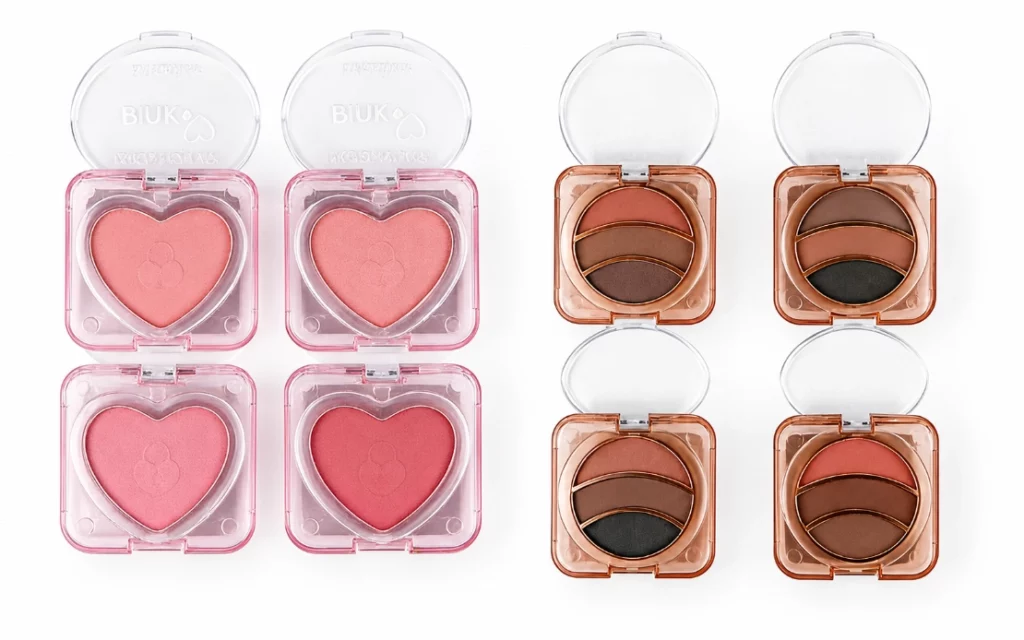
Mocoallure’s Heart-Shaped Powder Blush ES5110 gives the buyer two quantity references: 720 units for the ready-to-ship MOQ and 14,400 for OEM. The listed master carton holds 720. Attach these product-specific figures to the model reference, and confirm availability and terms for the requested version. A stock order and an OEM project are different purchasing routes.
ES5110 has a listed carton size of 58 × 52 × 37 cm; expressed in meters, that is 0.58 × 0.52 × 0.37, whose product is 0.111592 cubic meters. That is carton volume, before any pallet or consolidation allowance, and a useful starting input for the freight inquiry. Obtain confirmed gross weight and packing for the quoted version as well. Net powder weight cannot establish the shipping weight of the assembled order.
If the quotation uses that 720-unit packing, the listed quantities produce the following arithmetic. The OEM row is conditional on the same carton configuration; a customized pack needs its own confirmed inputs. Neither the freight price nor available stock can be established by this arithmetic.
| Quantity basis | Cases at 720 units per case | Carton volume before pallet allowance |
| 720 units | 1 | 0.111592 cubic meters |
| 14,400 units | 20 | 2.23184 cubic meters |
Use these packing inputs to ask for the two shipment estimates. A decision to change the pack also means revisiting the inputs sent to the forwarder, rather than carrying the old volume into a new order.
Count retail items before sharing the freight bill
A blush-and-brow shipment could bring one freight invoice but two SKU costs to calculate. An equal split per retail unit is one possible method. The question is whether that division reflects the space or weight behind the charge. Find out how the shipment is priced before choosing how to share the expense between its products.
Mocoallure’s Tri-Color Eyebrow Powder ES5106 has light, medium, and deep shades in one compact: one retail item rather than three. Its listed master carton also holds 720 units. For a mixed blush-and-brow order, obtain shipping data for each selected version; counting colors cannot tell you how to divide the freight bill.
A charge that arises from one product should remain identifiable against that item. A packaging change billed for one model belongs to that model; a shared broker charge needs an allocation basis. Use the same method for each purchasing option. Otherwise, a lower cost assigned to one SKU may simply be a cost moved onto another.
Testers and promotional units need a separate quantity column. They are part of the purchased and shipped order but may not be sold. Showing purchased stock and expected sellable stock in neighboring columns makes the difference visible. A unit-cost figure should identify which column supplied its denominator.
Match the delivery responsibilities before adding prices
Record the Incoterms rule, version, and named place or port beside each offer. Have the remaining journey priced on the same shipment details. Lay the product offer beside the freight offer and look for overlapping coverage. Where the seller has already included a stage of delivery, a separate price for that stage is a comparison input, not necessarily an additional bill.
FOB versus DDP cosmetics concerns responsibility as well as price. Under DDP, the seller handles import-clearance formalities under the rule; under DAP, the buyer handles them. That distinction is explained in ICC’s Incoterms guidance. FOB also needs the right transport context: the rule is for sea or inland waterways. An air order calls for an appropriate alternative.
Where a price bundles several stages together, ask for the scope and responsible parties in writing. Delivery terms belong to the order quotation; manufacturing support by itself leaves freight and duty-paid delivery unresolved.
Keep the customs and product-review inputs separate
A broker can address the import calculation for the selected goods using their description and origin, the invoice information, and the planned entry date. Supply those details with the request for classification, valuation inputs, duties, and entry charges. The delivered-stock budget in your cosmetics landed cost sheet serves a different purpose from customs declaration value. The global makeup sourcing checklist can help organize technical product information alongside that work; it does not replace classification review.
An older order may supply a useful starting record, but its duty assumption needs checking for the planned entry. USITC Harmonized Tariff Information lists the edition published on October 9, 2026. The publication date is a reference to retain, without treating it as evidence that all cosmetics tariffs changed.
Paying import charges does not settle market-entry work. FDA cosmetics importer guidance addresses the US product requirements. Identify who handles the applicable review, and budget label work or outside assistance explicitly. A paid duty bill is not a substitute for that product work.
Use confirmed product scope in the cost model
Specify what stays as supplied and which changes need development. An earlier price belongs to its earlier specification. If the buyer now wants another formulation or pack, describe the required work and establish its quotation before using a product price in the import budget.
Formula development, package design, and mass production are within Mocoallure OEM/ODM services. Describe that manufacturing work for the version you want quoted, then establish the delivery basis offered for the order. A separate transport offer should then address the uncovered part of the same route.
A source and status belong beside every amount: written quotation, confirmed charge, or estimate. Convert to one currency with the exchange-rate assumption visible. Where an amount might be recoverable, ask your adviser how to treat it; the cash needed to make a payment and its eventual economic cost may be different.
Calculate the units and the cash needed
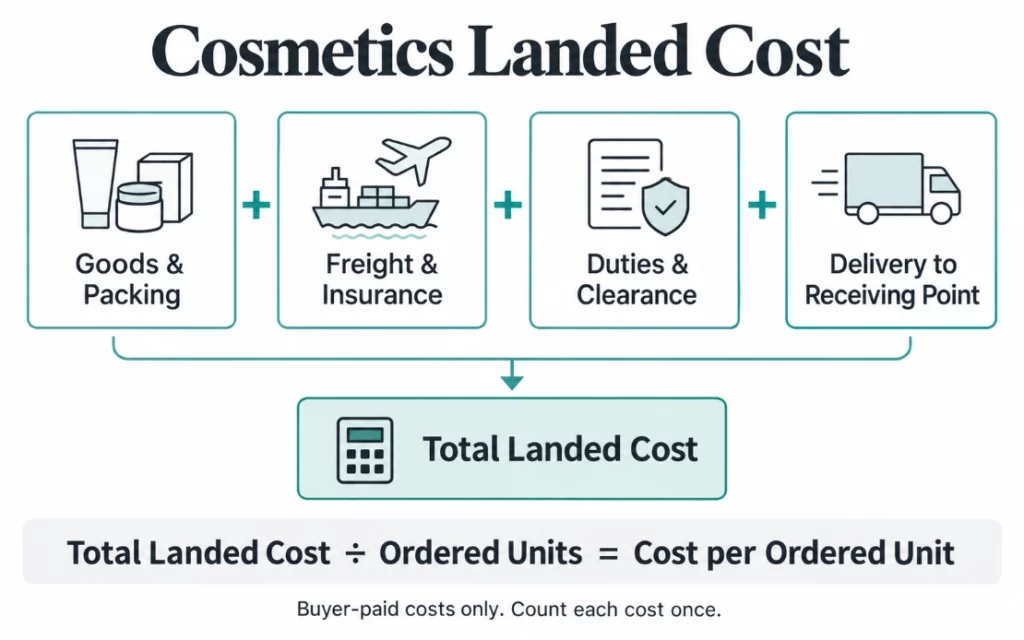
To see how the division works, take an illustrative order of 1,000 makeup units with the assumed costs below. These amounts have no connection to Mocoallure prices, an actual freight quotation, or an applicable duty rate. A buyer using this worksheet would replace them with quoted charges and reviewed calculations before seeking purchase approval.
| Included cost | Assumed amount in USD |
| Goods and quoted packing | 2,500 |
| International freight | 600 |
| Insurance | 40 |
| Duties, brokerage, receiving and final delivery combined | 460 |
| Total | 3,600 |
The first answer is $3,600 divided by 1,000, or $3.60 for each unit bought. For a second planning view, suppose 20 units are reserved for samples or display. Only 980 would be sold, so the same $3,600 is divided by 980 and comes to about $3.67 per sellable unit. Label the two answers: purchased stock and sellable stock are different denominators. Split the combined $460 line into individual charges in the working budget, so each has a source to check.
A lower unit cost on a larger order still means financing the stock, including its slower-moving shades. The funding decision needs both the unit saving and the money committed to the larger purchase. It also needs payment dates. A deposit, balance payment, freight bill, and entry charge can fall at different points, so place each beside its expected due date instead of relying on the budget total alone.
Conclusion
Build cosmetics landed cost around a defined receiving point and selected order, using confirmed packing, aligned quotation terms, and current import-charge inputs. The unit figure needs an identified denominator, and the purchase decision also needs the shipment’s cash requirement.
A freight inquiry for compact powder makeup needs the packed shipment’s dimensions and gross weight. The small quantity of powder inside each compact cannot supply either input. Changes to the order call for updated inputs. After arrival, the invoices give you a chance to reconcile the estimate with what was paid. The next order can then start from an explained record.
To request a product and packing quotation from Mocoallure, include the models and quantities with the US receiving point, customization brief, and preferred delivery basis. The resulting product and packing inputs can join the forwarder’s and broker’s figures in the import budget.
FAQ
Does cosmetics landed cost include selling expenses?
This model ends at the named receiving point. Advertising, platform fees, retailer discounts, later storage, and customer delivery enter the wider calculation of profit when that stock is sold. Put those in the profitability budget, keeping the receiving point visible as the boundary of this calculation.
How do I compare FOB and DDP offers?
Choose one receiving point for both orders and read each offer against the journey to that point. Add only the costs still borne by the buyer to reach that point. A DDP price may already include amounts that sit outside the product price in the other offer. Reconcile those items before adding further amounts to its price.
Can a mixed makeup order use one duty assumption?
Have the broker confirm classifications and applicable provisions for the selected products before applying a shared rate. The retail description ‘powder makeup’ leaves classification unresolved. Retain the broker’s dated reference with the estimate and ask what needs reviewing if the goods, origin, or entry plans change.